 Readprint
This is a fictional demo, not a customer story. The text and book list are the app’s fixed sample content, also used in our App Store presentation. They show the format, not measured accuracy or a guaranteed result. No new AI analysis was run for this page.
You test big ideas against lived reality
You keep choosing books that test a clean idea against the grain of real life. Whether the subject is a city, a scientific revolution, a moral judgment, or a quiet novel, abstraction only interests you once it meets people, history, and consequence.
Your reading map
Cities, buildings, and human scale
Seeing Like a State · The Death and Life of Great American Cities · A Pattern Language · How Buildings Learn
Knowledge under pressure
An Enquiry Concerning Human Understanding · Thinking, Fast and Slow · The Scout Mindset · The Structure of Scientific Revolutions
Systems made and remade
Thinking in Systems · The Information · The Making of the Atomic Bomb · The Craftsman
Lives inside institutions
The Remains of the Day · Middlemarch · The Warmth of Other Suns · Gilead
Time, nature, and perception
The Order of Time · The Peregrine · The Overstory · The Gene
The map groups representative titles; the complete 30-book list appears below.
What it reveals
You distrust systems that erase local knowledge
You notice what disappears when a plan becomes too neat. “Seeing Like a State,” “The Death and Life of Great American Cities,” and “How Buildings Learn” all stay close to adaptation, tacit knowledge, and the lives that resist a diagram.
You watch certainty change under pressure
A confident claim is only the beginning for you. Hume’s “Enquiry,” “The Scout Mindset,” and “The Structure of Scientific Revolutions” return to the same pleasure: watching evidence unsettle an answer without making careful judgment impossible.
You read for lives inside institutions
Your novels do not offer an escape from systems; they reveal their human cost. “The Remains of the Day,” “Middlemarch,” and “The Warmth of Other Suns” keep duty, reform, and history at the scale of a single life.
Here’s what I see
You keep the map and the street in view at once. That balance makes your reading exacting without becoming bloodless: ideas matter most when you can see whom they touch.
This portrait reflects recurring attractions in these confirmed titles, not your profession, biography, or agreement with any author.
The complete sample book list
These are the 30 titles used to construct the fictional demo. They are not the founder’s personal reading history, and they are not a list of books David Hume read.
- Seeing Like a State — James C. Scott
- The Death and Life of Great American Cities — Jane Jacobs
- A Pattern Language — Christopher Alexander et al.
- How Buildings Learn — Stewart Brand
- The Design of Everyday Things — Don Norman
- Thinking in Systems — Donella H. Meadows
- The Structure of Scientific Revolutions — Thomas S. Kuhn
- The Information — James Gleick
- The Beginning of Infinity — David Deutsch
- The Making of the Atomic Bomb — Richard Rhodes
- The Art of Doing Science and Engineering — Richard Hamming
- The Craftsman — Richard Sennett
- The Dawn of Everything — David Graeber & David Wengrow
- The WEIRDest People in the World — Joseph Henrich
- The Warmth of Other Suns — Isabel Wilkerson
- An Enquiry Concerning Human Understanding — David Hume
- Dialogues Concerning Natural Religion — David Hume
- The Undoing Project — Michael Lewis
- Thinking, Fast and Slow — Daniel Kahneman
- The Scout Mindset — Julia Galef
- The Remains of the Day — Kazuo Ishiguro
- Middlemarch — George Eliot
- Gilead — Marilynne Robinson
- The Overstory — Richard Powers
- Invisible Cities — Italo Calvino
- Labyrinths — Jorge Luis Borges
- The Peregrine — J. A. Baker
- The Order of Time — Carlo Rovelli
- The Gene — Siddhartha Mukherjee
- The Emperor of All Maladies — Siddhartha Mukherjee
An intellectual echo: Hume
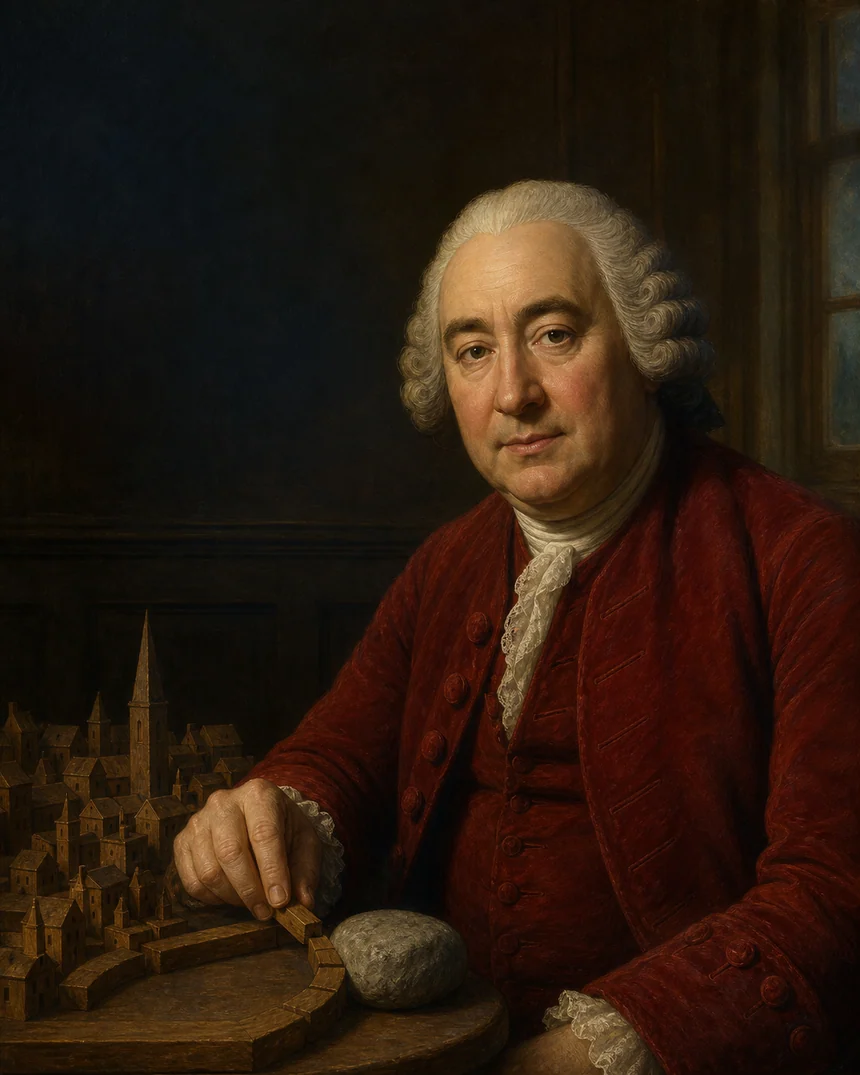
The demo connects Hume’s attention to evidence and human judgment with the philosophy, decision, and systems books in the list. It uses that connection as an artistic interpretation, not as a scientific similarity score or a claim about physical appearance.
Your own cover may feature a different historical echo or an original visual metaphor. See the sample cover with its title and branding.
What would make this interpretation convincing?
Look at the named books behind each observation. Do they support the connection? Would the sentence still work if you replaced them with a completely different shelf? Is the portrait noticing something specific, or simply offering a compliment?
This fictional example cannot answer how accurate Readprint will feel to you. Read the limits of a reading portrait, then prepare your own books if you would like to try it.